

TubeEqBtw is the broad, musical EQ that studios have run whole mixes through for decades: a passive network of coils, capacitors and resistors that only ever cuts, a tube pair that makes up the level, and a transformer on either side. Its knobs are the classic unit's: a low shelf you can boost and cut at the same frequency at once, a peak in the highs whose width you set, and a high shelf that cuts. Boost and cut the lows together and the curve lifts the bottom while it dips the low mids, the kick trick engineers reach for on drums and bass. The curve is the network's, solved from its circuit at every setting, and it plays with no latency. DRIVE pushes the tube pair harder while the level stays, EVEN sets the pair's balance, AUTO GAIN holds the loudness while you shape the curve, and CHANNELS works on the mid, the side, or the lows on the mid and the highs on the side. It is not a parametric or a surgical EQ: it has a few fixed frequencies and broad curves, by design.
Read the manual for every control and how to use it.
Screenshots
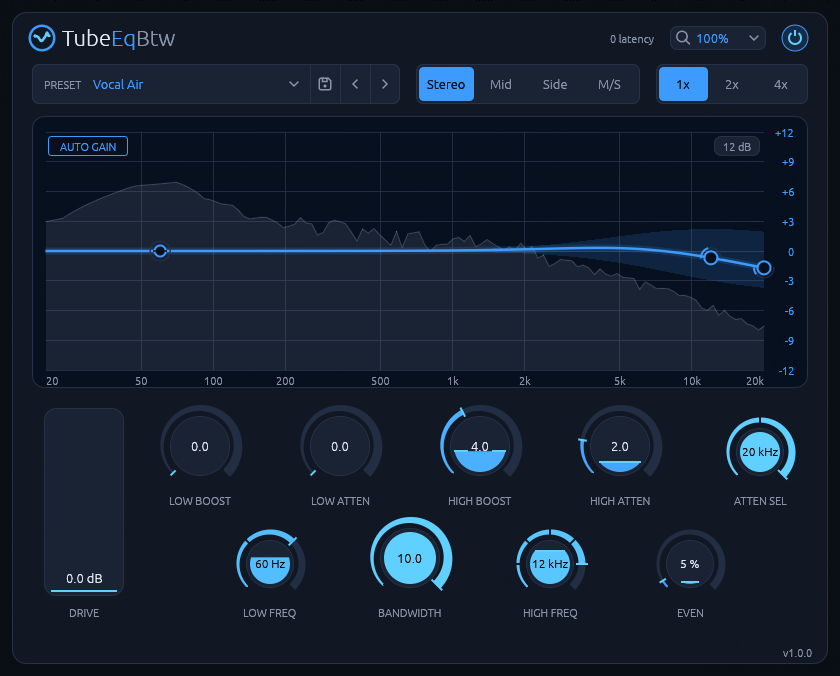
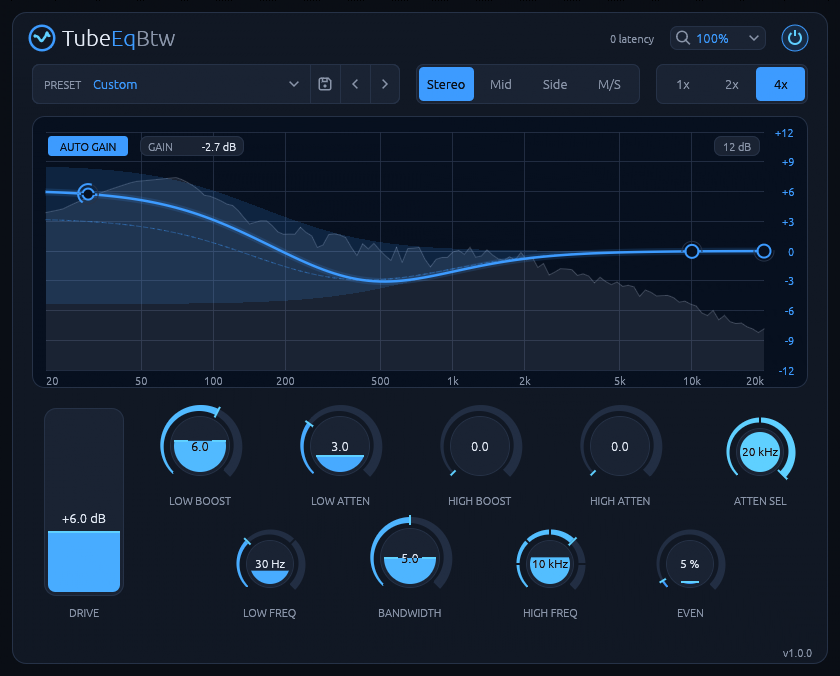
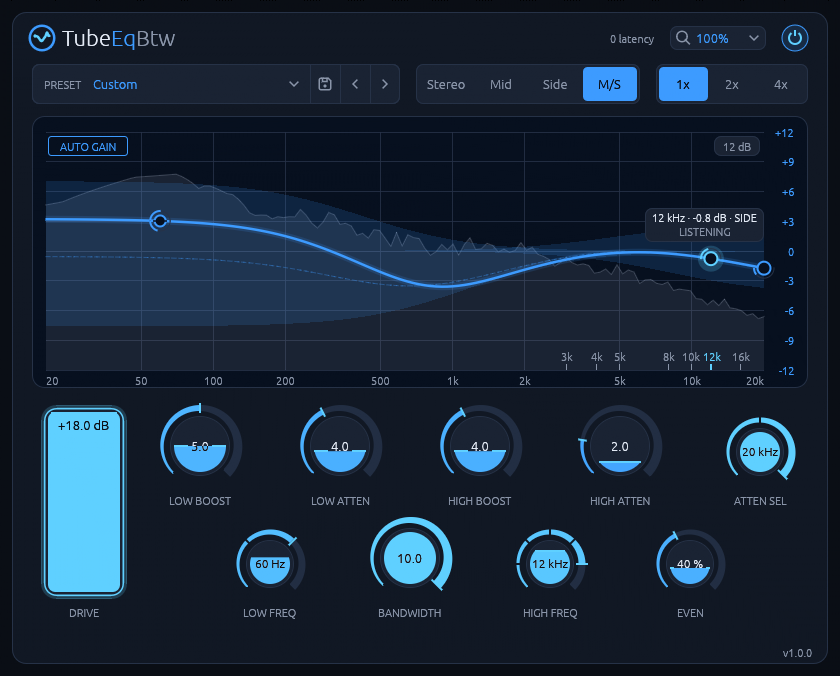
What it's for
Features
- The network's own curve: solved from its circuit at every setting of its switches and dials, within 0.05 dB of a reference model of the network. The sharpest high boost tops out at 18.5 dB, the broadest at 11.2 dB.
- No latency for the curve: it plays on a minimum-phase curve EQ, within 0.93 dB of the analog curve at its worst at 48 kHz. Every dial at 0 is flat within 0.1 dB from 20 Hz to 20 kHz.
- The kick trick: LOW BOOST and LOW ATTEN at once. Both at 5 at 60 Hz lift 20 Hz by 2.3 dB and dip the low mids at 784 Hz.
- A tube pair and two transformers: 0.053 % THD at −18 dBFS at DRIVE 0, 3.65 % at DRIVE +18 dB. A low boost drives the transformers harder, so the bass thickens while the top stays clean.
- DRIVE keeps the level, within 0.01 LU across its range once its level match has settled, about a second. Its fader glows as the tube rounds the peaks.
- EVEN: the tube pair's balance, from matched, its even harmonics cancelling, to one half alone with a strong second harmonic.
- AUTO GAIN: holds the loudness as the curve changes it, within 0.23 LU on a mix, a voice and drums, so a boost doesn't win just by being louder.
- CHANNELS: Stereo, Mid, Side, or M/S with the lows on the mid and the highs on the side.
- A display you can play: the curve heard, each band alone and the output's spectrum, with rings that move the knobs. Hold a ring to hear only where its band works.
- OVERSAMPLING for the tube: 1x has no latency; 2x and 4x add 43 and 50 samples and take the aliasing at high DRIVE from −28.7 dB to −49.2 and −85.0 dB.
- Light: 0.82 % of a CPU core at the defaults, stereo at 48 kHz, and next to nothing on silence.
- Presets: six built in beside Default, and your own.
- Zoom from 100 to 200 %.
- No network access and no telemetry.
Install
Download the latest version from the Releases page, or with these commands:
curl -LO https://github.com/jelly-comet/TubeEqBtw-release/releases/download/v1.0.0/TubeEqBtw-1.0.0-linux-x86_64.tar.gz
curl -LO https://github.com/jelly-comet/TubeEqBtw-release/releases/download/v1.0.0/TubeEqBtw-1.0.0-linux-x86_64.tar.gz.sha256
sha256sum -c TubeEqBtw-1.0.0-linux-x86_64.tar.gz.sha256 && tar xzf TubeEqBtw-1.0.0-linux-x86_64.tar.gz
cd TubeEqBtw-1.0.0-linux-x86_64
Install for your user:
mkdir -p ~/.clap
rm -f ~/.clap/TubeEqBtw.clap && cp TubeEqBtw.clap ~/.clap/
Or for all users:
sudo mkdir -p /usr/lib/clap
sudo rm -f /usr/lib/clap/TubeEqBtw.clap && sudo cp TubeEqBtw.clap /usr/lib/clap/
Removing the old copy first avoids overwriting a file a running host has loaded. Then rescan plugins in your DAW.
To uninstall:
rm -f ~/.clap/TubeEqBtw.clap
Your presets stay in ~/.local/share/TubeEqBtw/presets/; delete that folder too if you want them gone.
FAQ
Is it free?
Yes. The download is free and MIT-licensed.
Is there a VST3 or LV2 version?
No. Releases contain the CLAP plugin only.
Does it run on ARM, like a Raspberry Pi or Apple Silicon?
No. It needs Linux on x86-64, on a CPU with AVX2.
Which hosts does it work in?
Any CLAP host. It was tried in REAPER.
Does it work on Wayland?
Through XWayland. The editor also needs a Vulkan driver.
Can I use it as a parametric EQ?
No. Like the unit it follows, it has a few fixed frequencies and broad curves, one low shelf, one high peak and one high cut. Reach for it to shape a sound broadly, and for a parametric EQ to fix a narrow problem.
What's new in v1.0.0
20 Nov 2026 · Release on GitHub
TubeEqBtw 1.0: a passive program EQ with a tube stage, broad and gentle curves for a mix, drums, bass or a voice, and the low boost and cut that make the kick trick.
- The network's own curve: solved from its circuit at every setting, within 0.05 dB of a reference model, and played with no latency.
- The unit's knobs: LOW BOOST and LOW ATTEN at 20, 30, 60 or 100 Hz (both at once: the kick trick), HIGH BOOST at 3 to 16 kHz with its BANDWIDTH, and HIGH ATTEN from 5, 10 or 20 kHz.
- DRIVE pushes the tube pair up to +18 dB while the level stays, its fader glowing as the tube rounds the peaks. EVEN sets the pair's balance, from matched to one half alone.
- AUTO GAIN holds the loudness as the curve changes it, so a boost doesn't win just by being louder.
- CHANNELS: Stereo, Mid, Side, or M/S with the lows on the mid and the highs on the side.
- The display: the curve heard, each band alone and the output's spectrum, with rings that move the knobs; hold a ring to hear only where its band works.
- OVERSAMPLING 1x (no latency), 2x or 4x (43 or 50 samples) for the tube at high DRIVE.
- Presets: six built in beside Default, and your own.
- 0.82 % of a CPU core at the defaults, stereo at 48 kHz. Needs a CPU with AVX2.
License
MIT, see LICENSE. The licenses of the third-party code in the binaries are in
THIRD-PARTY-LICENSES.txt in each release archive.
VST is a registered trademark of Steinberg Media Technologies GmbH. CLAP is an open standard by the free-audio project. TubeEqBtw is an independent project, after the classic passive program EQ. It isn't affiliated with or endorsed by the makers of any hardware EQ.


